FIELD NOTE 002 · · 5 min read
AI Skills Should Be More Like Recipes Than Choreography
Every major model release should trigger an audit of our skills.
But if every release requires rewriting them, the problem may not be the model. It may be how the skills were written.
A skill should survive a more capable model taking a different route to the same correct result.
Model releases reveal brittle instructions
Many skills are written around one model’s successful trajectory.
They name an exact tool, prescribe each step, and expect the result to arrive through the same route every time.
That can work until the model changes. A new model may plan differently, choose a better tool, or combine steps that the previous model needed to keep separate.
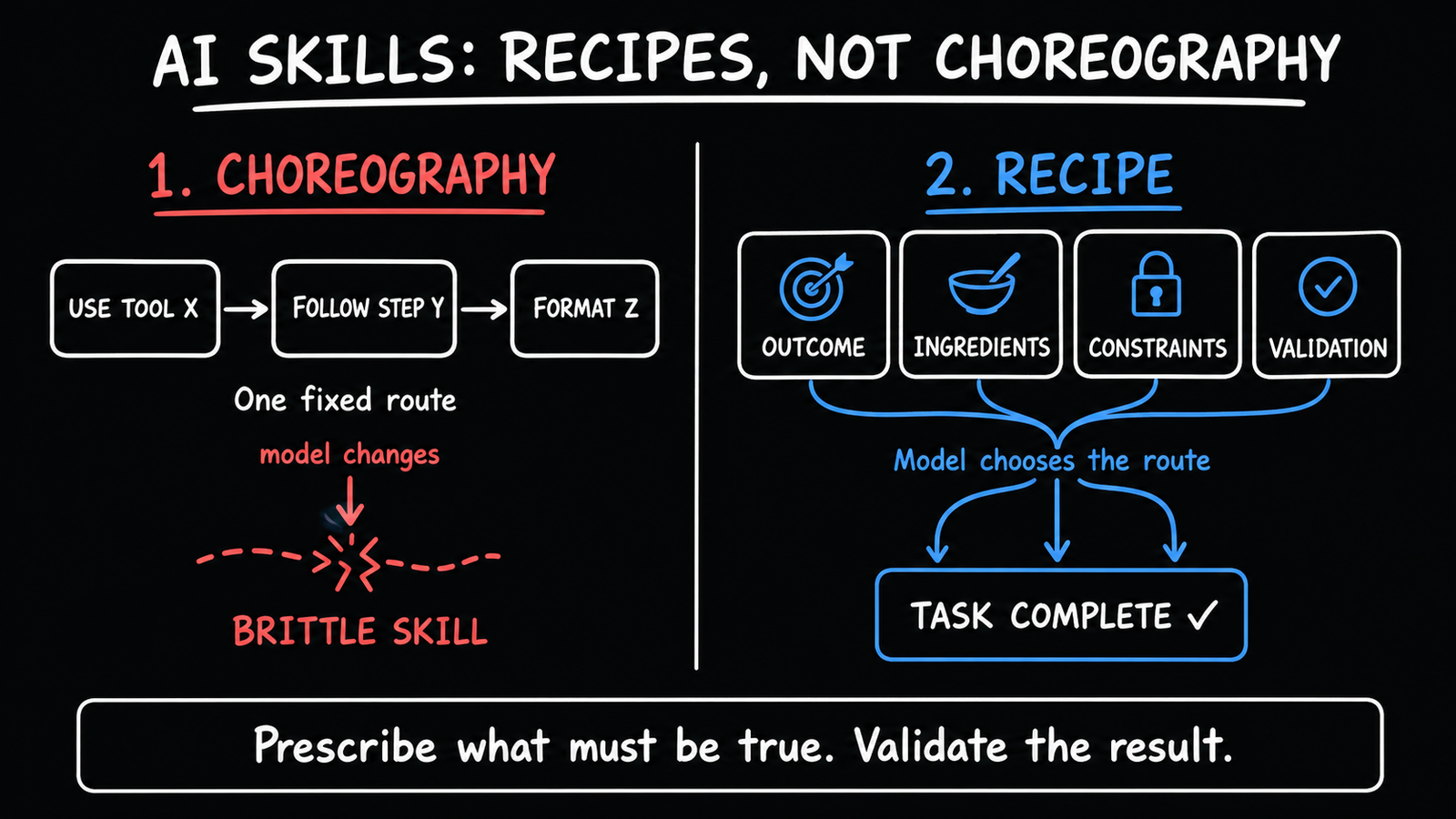
The diagram shows the difference. Choreography encodes one fixed route:
Use Tool X → Follow Step Y → Format Z
When the model changes, that route can become brittle even when the new model is perfectly capable of completing the task.
Choreography records every move
Choreography tells the performer exactly where to place each foot.
That precision is useful when every movement must be identical. It becomes a liability when the goal matters more than the route.
An overfitted AI skill often sounds like this:
Open Tool X, run Command Y, copy Field Z, retry twice, then format the answer exactly like this.
The instruction remembers how yesterday’s model succeeded. It does not explain why those moves matter or how to recognize a correct result.
If Tool X changes, or the new model finds a safer path, the skill may reject good work because it mistakes trajectory for correctness.
A recipe defines the finish line
A recipe works differently. It defines four things:
- The desired outcome.
- The available ingredients.
- The important constraints.
- How to validate completion.
The model can then choose the best route that respects those boundaries.
Consider a bread recipe:
Use flour, water, yeast, and salt. Develop the dough properly, then bake until golden and the internal temperature reaches 95°C.
It specifies what matters. It does not dictate which hand kneads the dough, the brand of oven, or every movement around the kitchen.
The ingredients bound the solution. The temperature provides evidence. The baker still decides how to work with the dough in front of them.
Give the model a durable contract
AI skills should follow the same principle.
Instead of recording the exact commands from one successful run, define the outcome, the constraints, and the proof that completion is real.
For example:
Identify the vulnerabilities, verify them against authoritative sources, remediate them without unrelated upgrades, run the relevant tests, and document any remaining risk.
This contract leaves room for the model to inspect the repository and choose the right tools. It still demands authoritative evidence, focused changes, tests, and an honest risk statement.
The route may change. The standard does not.
Keep explicit steps where order matters
Writing recipes does not mean being vague.
Recipes still specify sequence when sequence changes the result. Yeast needs time to work. A migration needs a backup before a destructive schema change.
Skills should remain explicit about:
- Safety boundaries.
- Irreversible actions.
- Compliance requirements.
- Required approvals.
- Correctness-critical ordering.
The distinction is whether a step protects the result or merely copies one model’s habit.
Prescribe what must be true. Suggest what often works. Validate what was achieved.
Audit the outcome, not the trajectory
When a new model arrives, replay representative tasks instead of rewriting the skill immediately.
Evaluate the results for:
- Correctness.
- Constraint violations.
- Reliability.
- Cost.
- Latency.
Do not mark a skill as broken simply because the model followed a different trajectory.
If the result is correct, the constraints hold, and the validation passes, the variation may be an improvement rather than a regression.
If the skill fails, ask which contract term was missing. Add the missing outcome, boundary, or check before adding more turn-by-turn navigation.
Write for tomorrow’s model
The best skill is not a recording of how yesterday’s model succeeded.
It is a durable contract for what tomorrow’s model must achieve.
Write recipes, not choreography.
NORMAL · BALANCE 0